If you import pet products, build a retail brand,or launch Amazon SKUs, or understanding how tofu cat litter is made is more than curiosity—it is due diligence. Plant-based litter has moved from niche to mainstream in many export markets, and buyers who can speak intelligently about the manufacturing process negotiate better terms, spot weak suppliers faster, and set realistic quality expectations with end customers.
This guide walks through the full production flow: raw materials, mixing and granulation, drying and screening, quality control, packaging, and export readiness. It is written for B2B buyers, not pet owners browsing retail shelves. Where factory capability matters, we reference what a production-ready tofu cat litter manufacturer should be able to demonstrate—not generic industry folklore.
What Tofu Cat Litter Is (and Why the Process Matters to Buyers)
Tofu cat litter is a plant-based granular product made primarily from food-industry byproducts—most commonly pea fiber, soybean residue, or similar starch-rich materials left over from food processing. Unlike mined clay, it is manufactured in a controlled factory environment. That distinction matters for three reasons:
- Consistency depends on process control, not geology. Two batches from the same line can differ if mixing ratios, drying temperature, or screening mesh change.
- Customization is possible. A capable factory can adjust granule size, scent level, color, and blend ratios for OEM and private label programs.
- Compliance and traceability start at the raw material intake, not at the finished bag.
For importers evaluating suppliers, asking "how is it made?" is often more revealing than asking for a glossy product brochure.
Raw Materials: What Goes In at the Start
The manufacturing story begins before any machinery runs. Reputable tofu litter factories source plant-based fiber from food-grade supply chains—pea fiber, soybean hulls, corn starch binders, and occasionally supplementary ingredients such as activated charcoal or natural scents.
Primary inputs
| Material category | Typical role in production | Buyer question to ask |
|---|---|---|
| Pea fiber / soybean residue | Base structure and absorbency | Is fiber food-grade sourced? |
| Starch or natural binder | Granule cohesion during forming | What binder system is used? |
| Activated charcoal (optional) | Odor control additive | Is it mixed in or surface-coated? |
Material quality directly affects dust levels, clumping behavior, and breakage during transport. Factories that operate at scale—such as facilities with annual output in the tens of thousands of tons—typically maintain multiple approved suppliers and incoming inspection records for each lot.
Step-by-Step Manufacturing Process
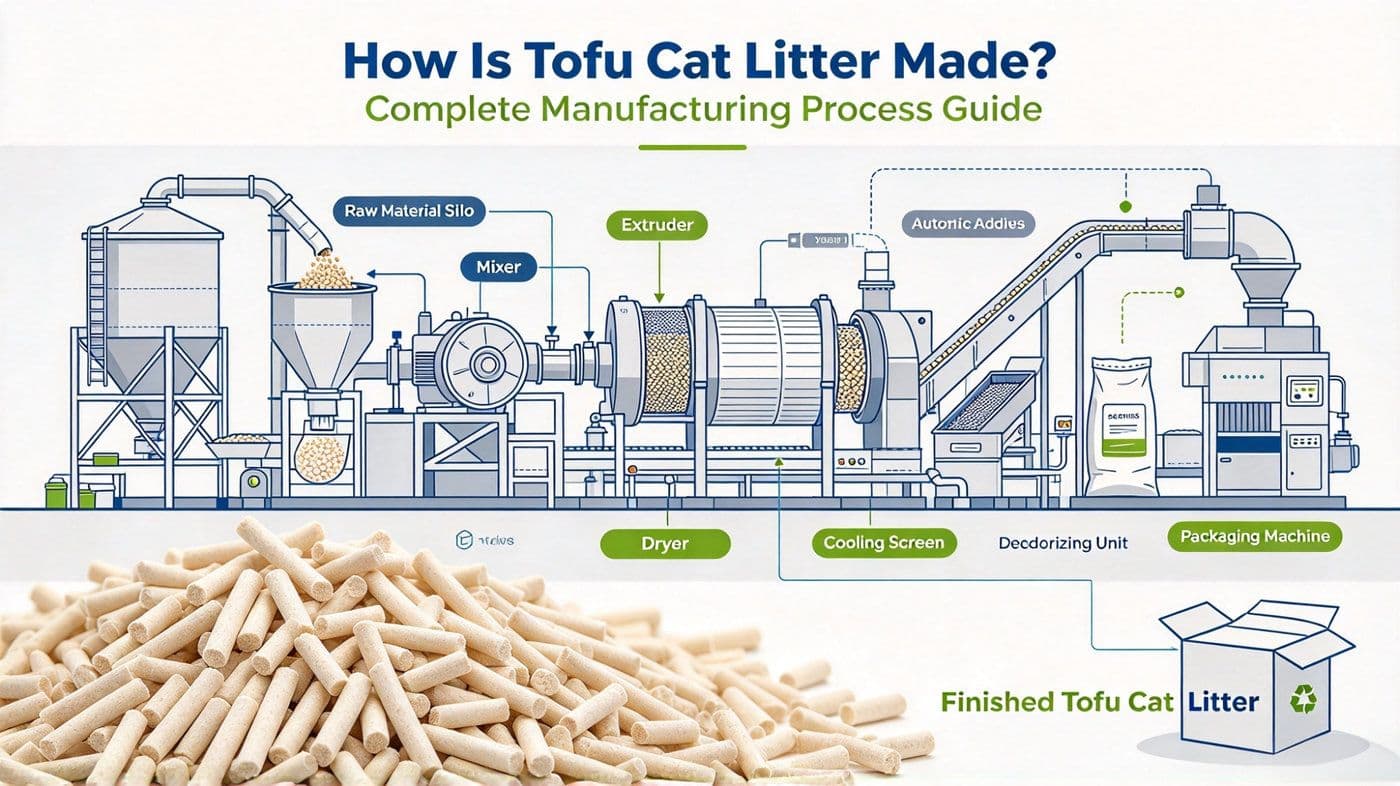
The core production flow at an ISO- and SGS-certified plant follows a predictable sequence. Individual factories may use slightly different equipment brands, but the logic is consistent across the industry.
1. Material preparation and weighing
Raw fiber arrives dried and milled to a controlled particle size. Operators weigh each batch according to the formula—whether that is a standard wholesale SKU or a custom private-label blend. Precision at this stage prevents drift in clumping and absorbency across production runs.
Automated weighing systems are common in larger facilities. Manual batching still exists at smaller operations, which increases variance risk. When touring a factory or reviewing a supplier questionnaire, ask how batch weights are recorded and whether deviation limits are enforced.
2. Mixing and hydration
Dry ingredients enter a high-shear mixer. Water or steam is added in measured amounts to activate binders and bring the mixture to the correct moisture level for extrusion or granulation. Mix time and temperature are controlled variables; rushing this step produces weak granules that crumble into fines.
Some manufacturers run separate mix lines for scented and unscented product to prevent cross-contamination—an important detail if your brand promise includes "fragrance-free."
3. Granulation (extrusion or pelletizing)
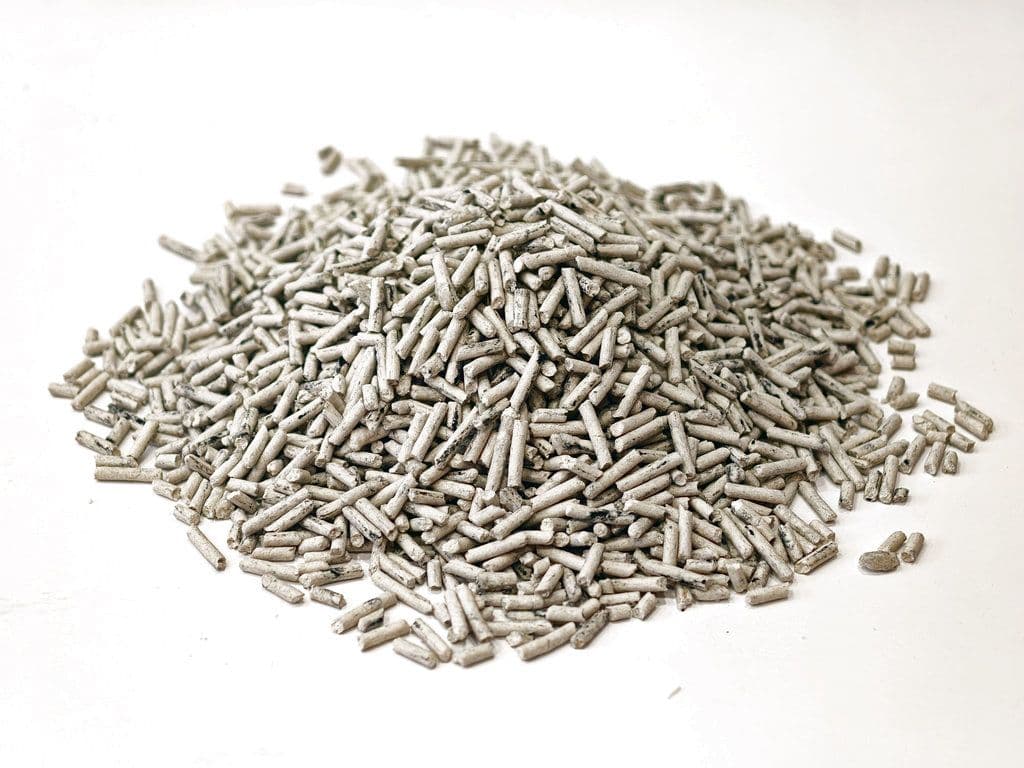
The moist mixture passes through an extruder or granulator that forms cylindrical or irregular pellets. Die size determines granule diameter—typically ranging from roughly 2 mm to 3.5 mm depending on product positioning (fine granules for indoor cats, larger pellets for low-tracking claims).
Granule shape affects:
- Tracking — longer pellets tend to stay in the tray better
- Clump formation — surface area influences how urine is absorbed
- Dust generation — fragile pellets break during handling
After forming, wet granules are still soft and must move quickly to drying.
4. Drying
Granules enter a rotary dryer, belt dryer, or fluidized-bed system. Hot air removes excess moisture until the product reaches a target level—usually low enough to prevent mold in sealed packaging but not so dry that granules become brittle.
Drying is one of the highest energy-cost steps in tofu litter production. Factories with modern dryer controls achieve more uniform moisture content, which translates to fewer customer complaints about inconsistent clumping.
Temperature control matters. Over-drying can darken granules and increase dust; under-drying risks microbial growth in transit.
5. Screening and classification
After drying, product moves through vibrating screens that separate granules by size. Oversized pieces are recirculated or milled down; undersized fines may be collected for reprocessing or discarded depending on factory policy.
This step defines the "dust profile" of the finished SKU. Buyers who specify low-dust product should confirm screen mesh size and whether the factory performs a post-screen aspiration step to remove loose particles.
6. Optional post-treatment
Some SKUs receive a secondary treatment:
- Surface scent application — fragrance oil applied in a coating drum
- Charcoal integration — already mixed in earlier, or added as a surface layer
Each post-treatment adds a changeover and cleaning cycle between runs, which affects MOQ and lead time for custom orders.
7. In-process and finished-goods quality control
QC is not a single checkpoint—it runs throughout production. Typical control points include:
| QC stage | What is checked | Why it matters for export |
|---|---|---|
| Incoming raw materials | Moisture, contamination, supplier COA | Prevents batch failures upstream |
| Post-mixing | Moisture and homogeneity | Catches formula errors early |
| Post-drying | Moisture content, granule hardness | Predicts shelf stability |
| Post-screening | Particle size distribution, dust ratio | Matches SKU spec sheet |
| Pre-packaging | Visual inspection | Final gate before labeling |
Factories holding ISO certification operate documented quality management systems—meaning deviations, corrective actions, and batch records should be retrievable. SGS testing or inspection reports may cover specific product lots depending on the supplier's export program.
If you plan to sell through major retailers or marketplaces with strict documentation requirements, confirm which test reports the factory can provide before you finalize packaging artwork.
8. Packaging
Finished granules are conveyed to automatic packing lines. Common export formats include:
- Stand-up pouches (500 g to 10 kg) with zipper closures
- Poly bags for value-tier SKUs
- Carton-packed multi-packs for club or wholesale channels
- Bulk super sacks for repackaging partners
Packaging lines typically include weight-check scales and metal detectors. For private label and OEM orders, the factory either applies your supplied film and cartons or sources them against your approved specifications.
Labeling must match destination-market rules—language, weight declarations, disposal guidance, and importer-of-record details. A production-ready manufacturer should flag common labeling gaps before print runs, not after containers are loaded.
9. Palletizing and export preparation
Bagged product is cartoned, stretch-wrapped, and staged for container loading. Export documentation—commercial invoice, packing list, certificate of origin, and phytosanitary or material safety sheets where required—depends on destination country.
Suppliers exporting to 40+ countries typically maintain experience with varied port requirements, though you should still confirm specifics for your market rather than assuming one document set works everywhere.
Ready to see product quality firsthand? A spec sheet only tells part of the story. Request a Free Sample from our production team and evaluate clumping, dust, and packaging before you commit to a container order.
How Manufacturing Scale Affects Your Order
Not every factory runs the same production model. Understanding scale helps you set realistic MOQ, lead time, and pricing expectations.
Sunbow Pet operates from a 6,000㎡ factory with annual capacity of 68,000 tons across plant-based litter lines. That scale supports:
- Wholesale catalog orders of standard tofu and cassava cat litter SKUs
- OEM/ODM customization with dedicated production windows
- Private label programs with custom packaging and formula adjustments
- Export logistics to 40+ countries with repeatable QC documentation
Smaller workshops may accept lower MOQs but struggle with batch consistency when orders spike. Very large orders require capacity proof—ask for production scheduling visibility, not just a verbal yes.
What Certifications Tell You (and What They Do Not)
ISO certification indicates the factory runs a structured quality management system: documented procedures, internal audits, and corrective-action processes. SGS involvement may cover product testing, factory audits, or pre-shipment inspection depending on the engagement.
Certifications are a baseline filter, not a substitute for your own evaluation. You should still:
- Order production samples from the actual line you will use
- Conduct or commission third-party testing if your retailer requires it
- Visit the factory or arrange a video audit for first-time partnerships
Avoid suppliers who claim certifications but cannot produce current certificates on request.
Packaging and Export Readiness Checklist for Importers
Before your first container ships, confirm the following with your manufacturing partner:
| Item | Confirmed? |
|---|---|
| Formula and granule spec locked in writing | ☐ |
| Packaging artwork approved with correct barcodes | ☐ |
| Net weight and language comply with destination law | ☐ |
| Shelf-life and storage guidance printed | ☐ |
| Batch coding system agreed (date/lot format) | ☐ |
| Inspection protocol defined (inline vs pre-shipment) | ☐ |
| Export documents list confirmed for target port | ☐ |
A factory experienced in export reduces surprises at customs—but the importer remains responsible for compliance in most markets.
Common Buyer Mistakes When Evaluating Manufacturing
Judging quality from a trade-show hand sample only. Trade samples may come from optimized pilot runs. Always request production-line samples.
Ignoring dust and breakage after simulated shipping. Drop-test a sample bag or ship it domestically before finalizing a long-term contract.
Assuming all plant-based litter is flushable. Flushability depends on granule composition, local plumbing rules, and how the product is marketed—not on the word "tofu" in the name. Align marketing claims with your legal review.
Skipping factory documentation review. If you cannot retrieve batch records or QC logs during due diligence, expect the same opacity after problems arise.
Frequently Asked Questions
How is tofu cat litter made differently from bentonite clay litter?
Bentonite is mined, crushed, and screened; tofu litter is manufactured from plant fibers through mixing, granulation, and drying. Plant-based production allows formula customization and controlled particle sizing that clay operations cannot easily replicate.
What raw materials are used in tofu cat litter?
Most formulas start with pea fiber or soybean residue from food processing, combined with natural binders. Optional additives include activated charcoal, corn starch, and natural scents. Exact ratios vary by SKU and are typically proprietary.
How long does tofu cat litter production take for a new OEM order?
Timeline depends on formula complexity, packaging sourcing, and MOQ. Standard catalog products ship faster than first-time custom blends requiring new screens, scent trials, or packaging tooling. Plan several weeks for sampling and approval, plus production and shipping lead time.
What quality tests should importers request?
Common requests include particle size distribution, moisture content, bulk density, and visual dust assessment. Some buyers add third-party microbiological or heavy-metal testing for retail compliance. Align test scope with your destination market requirements.
Can one factory produce both tofu and mixed (tofu + clay) litter?
Many large manufacturers run multiple lines or blend systems. Confirm cross-contamination controls if you market a "pure plant-based" brand alongside mixed SKUs.
Understanding how tofu cat litter is made equips you to ask sharper questions, compare suppliers fairly, and set accurate expectations for your customers. Whether you need standard tofu cat litter wholesale or a fully customized OEM run, the manufacturing process is the foundation of every claim on your packaging.
Next steps: Explore our OEM/ODM process for customization options, review our FAQ for common procurement questions, or Request a Factory Quote to start a project with a manufacturer exporting plant-based litter to 40+ countries.