Launching a private label cat litter line can look deceptively simple: pick a bag design, slapping your logo on a factory product, and import a container. Experienced brand owners know otherwise. Private label success depends on product choices, packaging engineering, sample discipline, and a manufacturing partner who treats your SKU as more than a generic granule fill.
This guide walks through the full private label journey—from initial product idea to export-ready finished goods. It is written for pet brands, retail chains, and distributors who want a structured road map before engaging an OEM factory. For the operational detail of how manufacturing partnerships work day to day, our OEM/ODM process page is the primary reference—this article explains what decisions you make at each stage and why they matter.
What Private Label Means in the Cat Litter Category
Private label cat litter is product manufactured by one company and sold under another company's brand name. The retailer or brand owner controls branding, packaging artwork, and often SKU specifications—but production happens at a specialized factory.
Private label differs from:
| Model | Who owns the brand | Who defines the formula | Typical buyer |
|---|---|---|---|
| Private label | You | You select from factory options or co-develop | Retailers, Amazon brands, distributors |
| OEM | You | Factory standard or customized per spec | Same as above; term emphasizes manufacturing |
| ODM | You | Factory assists with product development | New brands without in-house R&D |
| Wholesale (factory brand) | Factory | Factory | Importers reselling established catalog SKUs |
Most cat litter "private label" projects are OEM arrangements: you supply brand assets; the factory produces to an agreed specification. Sunbow Pet supports OEM, ODM, private label, and wholesale from a single 6,000㎡ facility with 68,000 tons annual capacity—giving brands room to start catalog-simple and evolve into fully custom SKUs.
Stage 1: Product Idea and Market Positioning
Before contacting factories, clarify what your private label line stands for. Manufacturing conversations go smoothly when you arrive with a brief—not a vague "I want good litter."
Define your positioning axis
| Decision | Options to consider |
|---|---|
| Material | Tofu/plant-based, cassava, mixed |
| Price tier | Value, mid, premium |
| Primary benefit | Low dust, odor control, lightweight, eco-disposal |
| Channel | Amazon FBA, pet specialty, grocery, export distributor |
| Bag sizes | 2.5 kg, 5kg, 10 kg—match channel norms |
| Target geography | US, EU, Southeast Asia |
Research competitor reviews in your target channel. Complaints about dust, tracking, or false clumping claims reveal opportunities—and warn you away from over promising on packaging.
Portfolio planning
First-time private label launches often succeed with one hero SKU—typically tofu cat litter in a mid-size pouch—rather than a five-SKU range on day one. Validate velocity, then extend into cassava, charcoal-enhanced, or mixed formats.
Browse the factory product catalog early to understand which base formulas exist versus which require new development time.
Stage 2: Formula and Product Specification Decisions
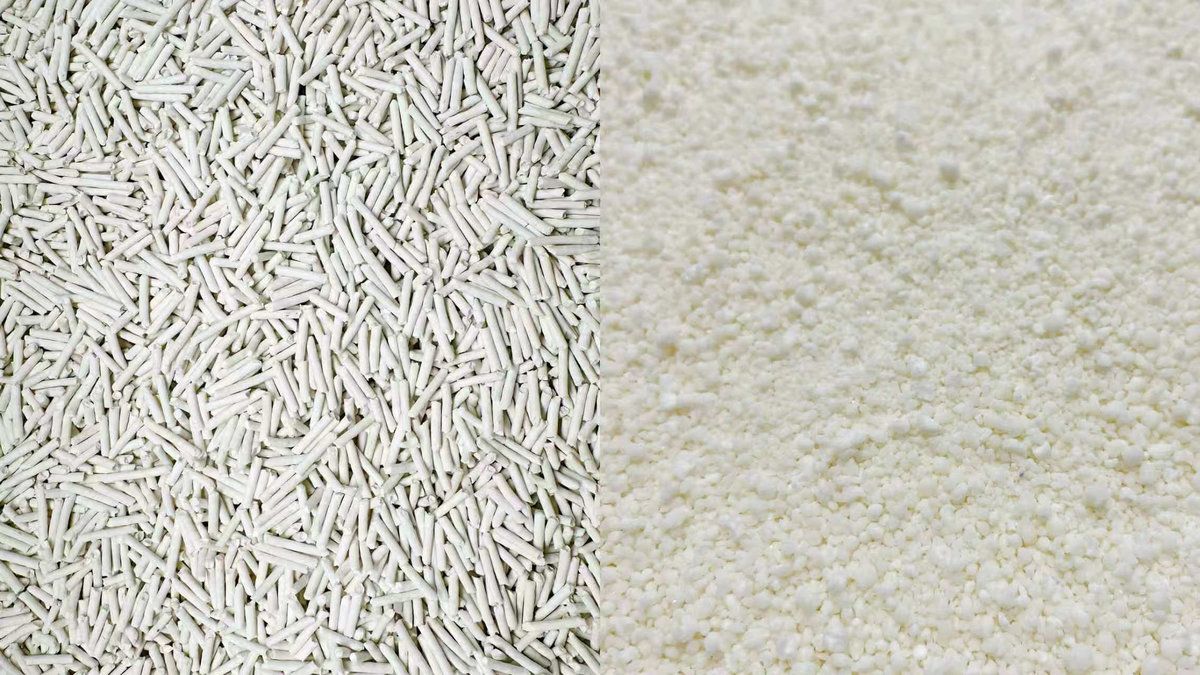
Formula choices lock in performance, cost, and marketing claims. Work through these with your OEM partner before packaging design finalizes.
Core formula elements
| Element | Brand decision | Manufacturing note |
|---|---|---|
| Base fiber | Pea fiber, soybean, cassava blend | Affects absorbency and story |
| Granule diameter | 2.0 mm, 2.5 mm, 3.0 mm, etc. | Impacts tracking and clump feel |
| Color | Natural, white, tinted | |
| Dust spec | low-dust grade |
Have a SKU concept but no formula yet? Share your target price and channel. Request a Free Sample of base grades and discuss customization with our project team.
Stage 3: Packaging and Branding
Packaging is where private label becomes visible. It also drives MOQ, lead time, and landed cost.
Packaging components
| Component | Owner typically | Lead time impact |
|---|---|---|
| Pouch film / bag structure | Factory sources | New print cylinder: weeks |
| Carton (if used) | Joint approval | Print plate timing |
| Label (if separate) | Brand owner artwork | Proof cycles |
| Barcode / GTIN | Brand owner | Must match retailer database |
| Pallet pattern / stretch wrap | Factory | Export efficiency |
Stand-up pouches with zippers dominate premium plant-based litter. Value tiers may use simpler poly bags. Match format to channel expectations—not only to design taste.
Artwork workflow
- Factory provides dieline (flat template with bleed and safe zones).
- Your designer produces artwork per destination-language requirements.
- Factory returns proof JPG for approval.
- Print plates created; film produced.
Stage 4: Sample → Quote → Order Flow
Understanding the commercial flow prevents projects from stalling between creative and production teams.
Typical sequence
Idea brief → Factory consultation → Formula samples → Spec sign-off
    → Packaging dieline → Artwork proof → Price quote / PI →
    Deposit → Bulk production → Inspection → Shipment
Quote components to review
| Line item | Question |
|---|---|
| Unit price | Based on which MOQ tier? |
| Packaging cost | Film, carton, insert—itemized or bundled? |
| Customization fees | New scent, screen size, plate charges |
| Sample charges | Credited against bulk or separate? |
| Incoterms | FOB port named? CIF insurance clear? |
| Payment schedule | Deposit percentage and balance trigger |
| Lead time | Production days after deposit and artwork approval |
Compare quotes only when spec sheets match. A lower per-bag price with weaker dust spec is not comparable.
Purchase order and PI alignment
Your signed proforma invoice (PI) should reference:
- Approved sample code
- PI version number
- Artwork approval date and file name
- Quantity, price, Incoterms, loading port
Treat the PI as the contract backbone—not a informal WeChat agreement.
Stage 5: Production, QC, and Export
Once production starts, your involvement shifts from creative decisions to monitoring and documentation.
Production milestones
1.Raw material intake 2.Mixing and granulation 3.Drying and screening 4.Packaging fill 5.Cartoning and palletizing
Ask for production photos or video at key stages if you cannot visit. Reputable factories accommodate reasonable transparency.
Export documentation
Export to 40+ countries requires experience with varied customs expectations—but you remain importer of record in most models. Confirm:
- Commercial invoice and packing list accuracy
- HS code consistency with product description
- Label language compliance
- Phytosanitary certificates for plant-based goods
Incomplete documents delay clearance and trigger storage fees at port.
Stage 6: Launch and Reorder Planning
First container arrival is not the finish line—it is the start of sell-through learning.
Launch checklist
- Listing copy matches approved claims (no drift from legal-reviewed packaging)
- Customer education on scooping and disposal (especially plant-based SKUs)
- Inventory plan for reorder lead time—litter sells faster than you expect when reviews improve
- Feedback loop: monitor returns and reviews for dust, scent, or clumping themes
Reorders and optimization
Successful private label brands often:
- Add a second size (trial bag + value bag)
- Introduce line extension (charcoal, cassava blend)
Scale conversations are easier with a partner already running your spec on known lines.
Timeline Expectations (Realistic Planning)
Exact timelines vary by customization depth. Use this planning framework:
| Phase | Typical duration (indicative) |
|---|---|
| Brief and factory consultation | 1–2 weeks |
| Formula sampling | 2–4 weeks |
| Packaging design and proof | 2–4 weeks |
| Print plate and film production | 2–4 weeks |
| Production sample and approval | 1–2 weeks |
| Bulk production | 2–3 weeks |
| Shipping (region-dependent) | 2–6 weeks |
First projects take longer than reorders. Build buffer before seasonal peaks (Q4 retail, rainy-season shipping delays).
Common Private Label Mistakes (and How to Avoid Them)
Underestimating packaging MOQ. Film printing may drive minimums more than litter tonnage.
Choosing factory on price alone. Lowest quote with no QC documentation is expensive when containers arrive wrong.
Working With a Manufacturing Partner
Private label cat litter is a collaboration, not a one-off purchase. Evaluate partners on:
- Documented capacity (e.g., 68,000 tons/year scale for growth headroom)
- Certification baseline (SGS product test)
- OEM/ODM/private label program clarity
Frequently Asked Questions
How much does private label cat litter cost?
Pricing depends on formula, packaging, MOQ, and Incoterms. Factories quote per metric ton or per bag at defined volume tiers. Request a formal quote after spec alignment—not a ballpark from a catalog screenshot.
What MOQ is typical for a first private label order?
MOQ varies by packaging print requirements and factory policy. Custom printed pouches often carry higher MOQs than plain or factory-stock film. Discuss MOQ early in the OEM process conversation.
Can I use my own packaging design?
Yes. Most private label programs accept buyer-supplied artwork applied to factory-sourced film or buyer-specified materials. Confirm dieline specs and proof cycles.
What is the difference between OEM and private label cat litter?
In practice the terms overlap. OEM emphasizes manufacturing under your brand; private label emphasizes retail exclusivity positioning. Both require agreed specs, artwork, and production samples.
Private label cat litter succeeds when brand decisions, manufacturing discipline, and documentation align before the first container ships. Move through idea → formula → packaging → sample → production with signed specs at each gate, and you build a SKU that reorders.
Ready to start? View OEM Process for partnership details, Request an OEM Quote with your brief, or explore wholesale catalog starting points while you finalize your private label specification.


